
Table Of Contents
Manohar Lal
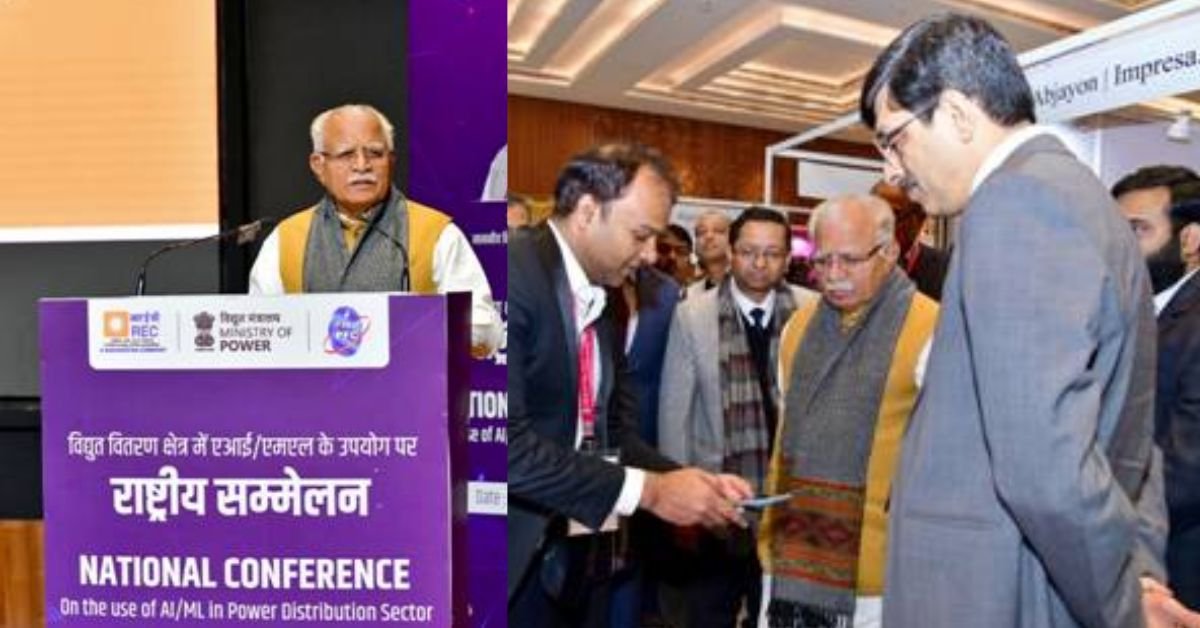
In a bold vision for India’s energy future, Union Minister of Power Shri Manohar Lal emphasized today that Artificial Intelligence (AI) and Machine Learning (ML) will be game-changers in creating more intelligent and efficient power distribution networks.
Speaking at the ongoing two-day National Conference on AI/ML in the Power Distribution Sector at Bharat Mandapam here, the minister highlighted how these technologies could foster self-optimizing systems tailored to consumer needs.
The event, organized under the Revamped Distribution Sector Scheme (RDSS) by the Ministry of Power in collaboration with REC Limited and Power Finance Corporation (PFC), drew innovators, state utilities, and tech experts.
It kicked off yesterday with a national innovation call that attracted 195 applications from distribution companies (DISCOMs), Advanced Metering Infrastructure Service Providers (AMISPs), Technology Solution Providers (TSPs), and Home Automation Solution Providers (HASPs).
After rigorous jury evaluations, 51 solutions advanced, showcasing cutting-edge tools like predictive analytics and digital twins.
Spotlight On Winning Innovations
Shri Lal felicitated the top performers, urging them to scale their breakthroughs nationwide.
Here is a snapshot of the winners and their standout contributions:
| Category | Winner(s) | Key |
|---|---|---|
| DISCOMs | TNPDCL (Tamil Nadu), MP East DISCOM (Madhya Pradesh) | Advanced smart meter analytics for revenue protection; precise consumer indexing to slash losses by up to 20% through data-driven detection. |
| AMISPs | Tata Power, Apraava Energy | Behavioral demand-response systems and AI-automated operations, enabling real-time grid balancing and reduced peak-load strains. |
| TSPs | Pravah, Flock Energy | Unified real-time grid intelligence platforms; appliance-level analytics for granular energy insights, empowering users to cut bills by 15-25%. |
| HASPs | Tata Power | User-friendly home automation for remote monitoring and control, integrating voice commands with AI for seamless energy management. |
These solutions, presented today, demonstrate practical AI/ML applications: from theft detection that safeguards honest payers to outage predictions that minimize downtime.
As Shri Lal noted, such tech not only boosts operational efficiency but also rebuilds consumer trust by curbing losses and optimizing costs, potentially saving DISCOMs billions in aggregate technical and commercial (AT&C) losses, which hover around 15-20% nationally.
Consumer Engagement: The Linchpin Of Tech Adoption
A recurring theme was the minister’s call for “active consumer engagement.”
He emphasized the importance of dispelling myths surrounding innovative technology, such as privacy concerns with meters, and engaging households in energy decisions.
“Technology restores trust when consumers are partners, not just beneficiaries,” Shri Lal said, pointing to AI-driven insights that let families track appliance usage in real-time, fostering sustainable habits.
This aligns with broader RDSS goals, which have already rolled out over 10 crore smart meters since 2021, aiming for complete coverage by 2026.
However, adoption lags in rural pockets due to digital divides.
Shri Lal’s push for collaborative ecosystems, linking DISCOMs with startups and academia, could accelerate this, mainly as India targets net-zero emissions by 2070.
Ministerial Launches And Roadmaps For Scale-Up
Adding momentum, the minister launched STELLAR (Strategic Expansion for Long-Term Load Adequacy and Resilience), a Central Electricity Authority (CEA) tool for DISCOMs to forecast demand and plan resilient infrastructure.
Complementing this, the India Smart Grid Forum (ISGF) unveiled a comprehensive handbook on AI, ML, AR/VR, and robotics in the utilities sector.
Packed with 174 use cases, 45 from Indian firms, it serves as a blueprint for grid modernization, from predictive maintenance to GenAI decision aids.
Shri Pankaj Agarwal, Power Secretary, echoed these sentiments, committing to nationwide digitalization.
“We need secure data frameworks and capacity building to turn pilots into pan-India realities,” he said, underscoring interoperability for seamless scaling.
Why This Matters: India’s Leap To Global Grid Leadership
This conference is not just talk; it is a catalyst for action.
With India’s power demand projected to double to 2,000 GW by 2040, AI/ML could reduce losses by 5-10%, freeing up funds for the integration of renewable energy sources.
Drawing from global peers like Singapore’s AI-optimized grids, India risks falling behind without swift adoption.
However, successes like TNPDCL’s analytics, which boosted collections by 12% in trials, signal promise.
Challenges remain: cybersecurity in AI systems and equitable access in underserved areas.
However, as Shri Lal envisioned, these innovations position India as a digital electricity pioneer, blending technology with empathy for a resilient and inclusive grid.
For utilities and consumers alike, the message is clear: AI is not disrupting power, it is powering progress.
Stay tuned to brieffeeds.com for updates on RDSS rollouts and winner implementations.
Post's Author