
Table Of Contents
Introduction: “The Drug Problem Is Not Just Bad, It Is Becoming India’s Biggest Problem”
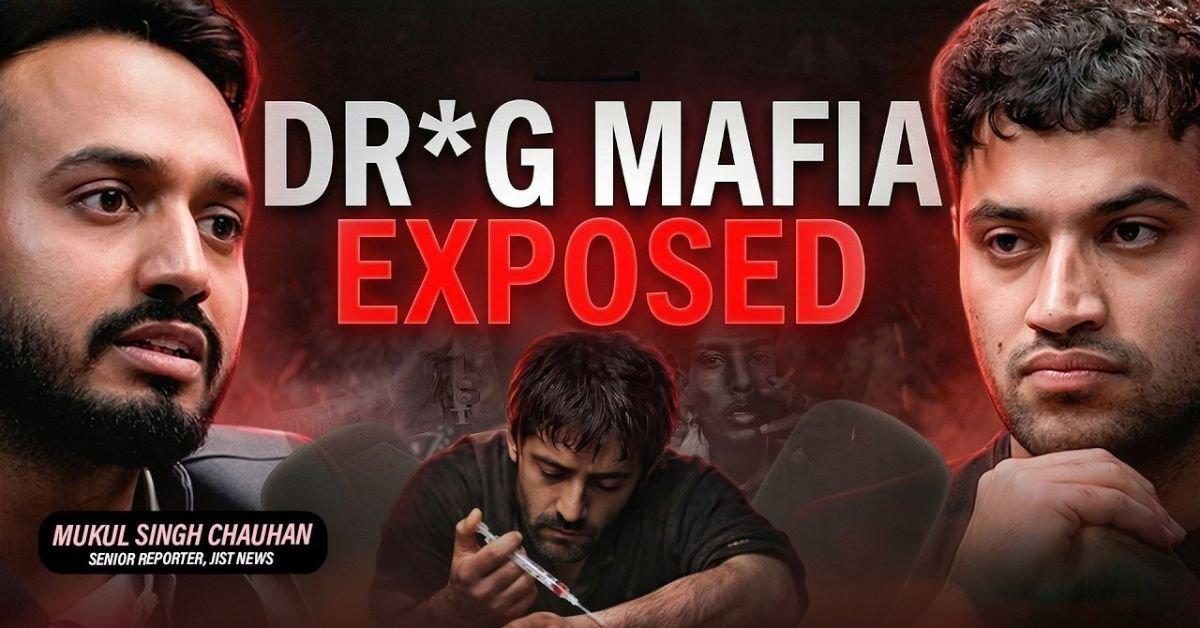
In a no-holds-barred conversation on Raj Shamani‘s podcast, investigative journalist Mukul Singh Chauhan, one of India’s most fearless ground reporters, exposed the horrifying reality of the drug crisis sweeping Punjab and rapidly spreading to other states.
Mukul did not rely on hearsay.
He and his team spent an entire week in Bhatinda, Punjab.
They met peddlers, people with an addiction, shattered families, rehab doctors, and even filmed themselves buying drugs on camera in broad daylight at 3 PM.
Mukul’s opening words set the tone:
“The drug problem is not just bad. It is becoming one of India’s biggest problems and growing every single day. From where we are sitting right now, the problem is worsening daily. Punjab’s reports are screaming this truth.”
He made it crystal clear: this is no longer a “Punjab-only” issue.
It has become a national emergency fueled by a sophisticated mafia network, drone smuggling, porous borders, and a massive parallel black-money economy that has allegedly compromised every level of the system.
Mukul Singh Chauhan: Who He Is And Why His Voice Matters
Raj Shamani asked Mukul to introduce himself to someone who had never seen him before in 60 seconds.
Mukul replied:
“I travel across the country, reaching corners and people others do not go to. I meet those whose lives and challenges most people never understand. I investigate on the ground and bring raw reality to the screen. I am a reporter who prefers to go to the ground, collect the truth, and place it in front of you.”
He quoted and slightly modified poet Adam Gondvi’s sher:
“Aaiye mehsoos kariye zindagi ke taap ko, main reporting ki gali mein le chalunga aapko.” (Come, feel the heat of life, I will take you through the lanes of reporting.)
Mukul stressed that journalism is not just about content; it must create a real impact.
The Ground Investigation In Bhatinda: What Mukul Saw With His Own Eyes
Mukul and his team lived in Bhatinda for a week.
They spoke to peddlers, people with an addiction, families who had lost everything, and even one major drug lord.
The most shocking moment: at 3 PM in broad daylight, they bought drugs on camera from a street peddler.
While traveling from Bhatinda to Ludhiana, within just 90 minutes, Mukul witnessed two incidents that showed how normalised the crisis has become:
- A 16-year-old boy was openly injecting near a thermal plant. When he saw Mukul, he panicked, threw the syringe, and ran.
- Under a bridge, a group was carrying an unconscious boy who had overdosed.
Mukul said:
“This is not me exaggerating. Your own government data is saying people are dying of overdoses. The Health Ministry itself tabled the numbers in Parliament.”
How The Mafia Network Operates: From Afghanistan To Your Street
Mukul obtained the entire supply chain directly from a peddler he interviewed on record:
- Origin: Mainly from Afghanistan (Golden Crescent) and some southern routes.
- Smuggling method: Not huge consignments. Instead, tiny packets are smuggled across porous borders and, increasingly, via drones.
- First hub: Delhi.
- Punjab level: Handed over to a drug lord who receives massive quantities.
- Street level: Distributed to small-time peddlers in tiny pockets.
Mukul explained:
“It reaches Delhi, then Punjab. One drug lord there has a huge stock. From there, it is distributed to peddlers. Then the most dangerous part begins.”
The Deadly Business Model: Free Drugs For 6 Days To Create Lifelong Addicts
This is the most chilling part of the podcast.
Mukul quoted the peddler verbatim:
“First, give it free for six days. Why? On the seventh day, the same person who gave it to you for free will start selling it to you. Hook them with free samples, get them addicted, then extract money.”
Target: Young boys aged 17-18.
Tactic: Peer pressure (“Bhai, try kar, sab dard, bimari, takleef khatam ho jayegi”).
Many resist for 3-4 times, but eventually give in.
Once hooked:
- Heroin (“chitta”) sells for ₹3,500 per gram.
- When money runs out, the person with an addiction is forced to recruit new users to keep getting his own supply.
This creates a self-sustaining pyramid scheme of addiction.
The Physical Destruction: Stage-By-Stage Horror Of Addiction
Mukul described the progression with graphic detail (supported by photos he showed):
- Stage 1: Chasing on foil.
- Stage 2: Injecting in arms and legs.
- Stage 3: Veins collapse and become blocked.
- Stage 4 (Deadliest): When visible veins are finished, users inject into the sensitive vein near the private parts (penis area). This gives the most extreme high but carries the highest chance of immediate death.
He showed a real addict’s arm:
“Look at these marks. These are syringe marks. First, they use foil, then injections. When arms and legs are finished, they move to the most sensitive part of the body.”
The Explosive Health Crisis: HIV Explosion And Overdose Deaths
Official numbers Mukul quoted (from the Ministry of Health and Family Welfare, tabled in Parliament):
- 2020-21: Approximately 500 HIV cases in Punjab due to shared needles.
- 2024-25: 90,000 HIV cases.
Mukul explained how it spreads:
“Five boys are sitting together. One has HIV. They share the same syringe. In minutes, all five become positive.”
Punjab leads the country in drug-overdose deaths.
Real Story: In Ludhiana, a mother lost all six sons to drug overdoses in one year.
Real Stories From The Ground: Families Destroyed
Mukul visited families where addiction had wiped out everything.
One father handed his own son over to the police because the boy had sold the entire house, fans, utensils, everything, to fund his addiction.
The father begged:
“Sir, please arrest him. I have no other option.”
Mukul interviewed the person with an addiction, his mother, and his father.
The boy was a former state-level volleyball player who could no longer play for even 15 minutes due to injuries.
Why The Problem Is Not Being Solved: The Parallel Black-money Economy
Mukul’s most damning revelation:
“The issue is not being solved because a huge parallel economy of black money and drug money has been created, and everyone is involved.”
- Punjab CM Bhagwant Mann promised to end the drug problem in 3 months and launched “Yudh Nashhe Virudh” (War Against Drugs).
- Yet numbers keep rising.
- Drug money funds lavish bungalows (later demolished in raids), but the network continues.
- Officials at every level are allegedly compromised. Enforcement is selective.
Mukul said clearly:
“When the system itself is involved, how far can you really go?”
The Delhi Missing Persons Controversy: 54 People Disappearing Every Day
Mukul also covered the January 2025 controversy:
- From 1 to 15 January, 807 people went missing from Delhi, 54 per day.
- Delhi Police PRO Sanjay Tyagi called it “usual” and “normal”, claiming there was no increase compared to previous years.
- Mukul cross-checked the Zipnet portal (official police missing persons database):
- Actual untraced numbers were even higher (~900+ in the recent 15-day period).
- Over three years, the average remained 1,100–1,300 missing in the same fortnight, but untraced cases are rising.
He warned:
“These are not just numbers. These are human beings, minors, women and the elderly. Behind these disappearances are child trafficking, bonded labour, sex trafficking, and drug-related networks.”
Mukul criticised both media sensationalism and the police’s defensive “nothing unusual” response.
Mukul’s Final Message: Journalism That Creates Impact
Mukul ended by reiterating that real journalism must go to the ground, show uncomfortable truths, and push for change.
He appealed to viewers and authorities:
“I have shown you the ground reality. The data is from your own ministries. Now it is time for action, not denial.”
Conclusion: A National Emergency That Can No Longer Be Ignored
The Punjab drug crisis is no longer a state issue.
It is a national emergency destroying an entire generation.
- A mafia network running on black money.
- Free drugs are turning teenagers into lifelong addicts.
- HIV is exploding from shared needles.
- Overdoses claim lives daily.
- Thousands are disappearing every month.
Mukul Singh Chauhan’s on-ground investigation, raw footage, and data-backed exposé leave no room for denial.
The question is no longer “Is there a problem?” The question is: What are we going to do about it?
Action
- Share this blog with parents, teachers, and policymakers.
- Demand accountability from leaders who promised quick solutions.
- Support ground-level investigative journalism that brings uncomfortable truths to light.
- If you or someone you know is struggling with addiction, seek help immediately. Rehab centres and helplines exist.
This is not just a podcast. This is a wake-up call for India.
Watch the original episode on Raj Shamani’s channel.
Every word comes directly from Mukul Singh Chauhan’s conversation.
No exaggeration.
Only ground reality.
What are your thoughts?
Is the drug crisis India’s biggest unspoken emergency?
Drop your comments below.
If this post moved you, share it.
One conversation can save a life.
Post's Author