
Table Of Contents
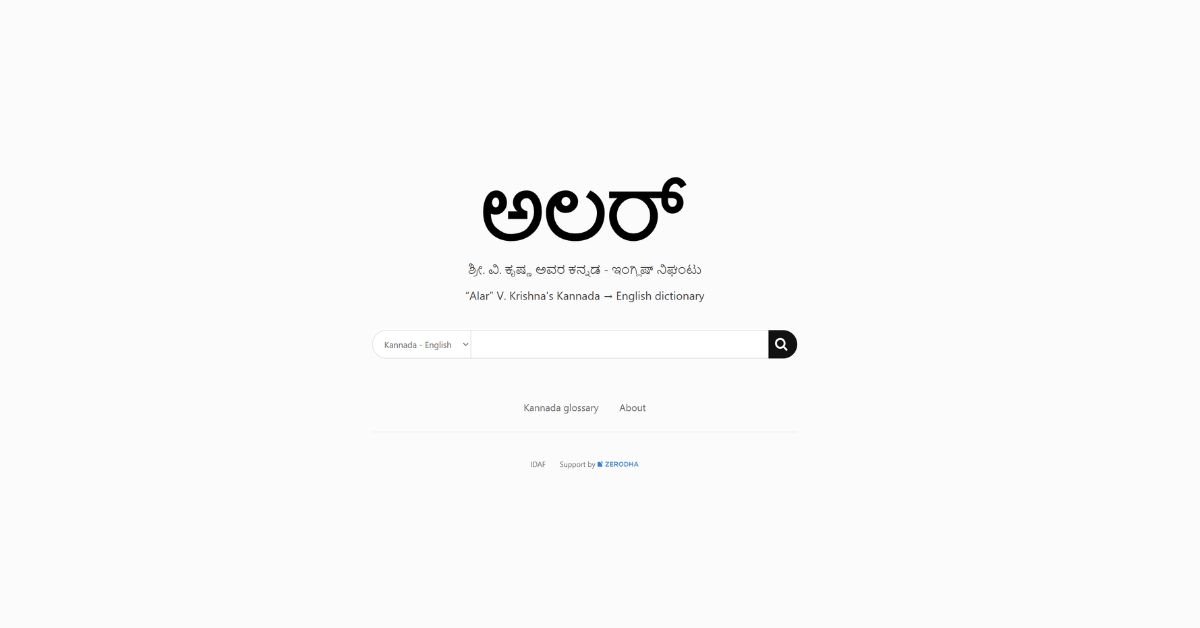
Alar
In the fast-paced world of stock trading, where algorithms hum and markets fluctuate by the minute, Zerodha‘s story stands out for its quiet detours into unexpected territories.
On December 3, 2025, co-founder and CEO Nithin Kamath took to X (formerly Twitter) to reminisce about one such detour: the open-sourcing of Alar, a comprehensive Kannada-English dictionary.
What began as an “odd” side project for a brokerage firm has blossomed into a digital lifeline for language learners, researchers, and everyday Kannada speakers worldwide.
Alar’s roots trace back to the 1970s, when V. Krishna, a soft-spoken retiree from Karnataka, embarked on a solitary odyssey.
Without fanfare or funding, he hand-compiled entries, learned to type in Kannada script, and digitized his work, all on his own.
Over the course of four decades, this hobby evolved into a monumental corpus: more than 150,000 Kannada words paired with 240,000 English definitions, complete with parts of speech, phonetic notations, and etymological notes.
“Just thinking about someone spending four decades relentlessly pursuing one single project is beyond inspiring,” Kamath wrote in his post, capturing the raw dedication that turned Krishna’s bedroom desk into a linguistic goldmine.
The unlikely bridge between Krishna’s passion and the digital age came via Zerodha’s CTO, Kailash Nath.
In 2016, Nath, himself a Kannada enthusiast, pitched the idea of digitizing Krishna’s Word document to Kamath.
True to Zerodha’s ethos of reinvesting profits into public good through its Rainmatter Foundation, Kamath greenlit the project without hesitation.
By 2019, after parsing ASCII text into Unicode, structuring data in Excel, and building a custom search engine, Alar bloomed online at Alar.ink.
The name? A poetic Kannada word for “to bloom,” drawn straight from Krishna’s own entries.
A Major Upgrade After Five Years
Fast-forward to today: Alar marks its fifth anniversary not with cake, but with code.
Kamath announced a “major update” that supercharges the site’s speed, making searches snappier for its 200,000+ monthly visitors, up from lakhs in earlier reports.
Behind the scenes, Nath has refined DictPress, the open-source WordPress plugin that powers Alar and similar tools, such as the Malayalam-English Olam dictionary.
This tech stack now abstracts tokenization for any language, enabling phonetic searches (e.g., typing “hesaru” to find ಹೆಸರು) via integrations like Varnam.
GitHub activity confirms the momentum: The alar-dict repository saw updates as recent as November 30, 2025, with the core data licensed under the Open Database License (ODbL) for unrestricted reuse.
Krishna, now in his twilight years, continues contributing entries, ensuring Alar’s corpus grows organically.
Why This Matters Beyond Words
At first glance, a stockbroker championing dictionaries feels absurd, as Kamath admits.
However, dig deeper, and it is a masterclass in cross-domain impact.
Zerodha, India’s largest retail brokerage with over 10 million clients, has long prioritized education over ads, pouring resources into literacy via Rainmatter.
Alar exemplifies this: it is not just a tool, but a cultural preserver for Kannada, one of India’s 22 scheduled languages spoken by 45 million people.
Insights from users highlight its reach.
An Indic language researcher told Kamath that Alar has become “an important resource in US academia for Kannada and South Asian language studies.”
On Reddit, Bangalore locals praise its minimalist interface for self-learning, while educators use it to teach bilingual kids.
In an era of AI-driven translations, Alar’s human-curated depth offers authenticity, as it avoids nuanced idioms that Google Translate often mangles.
This is not charity; it is strategic foresight.
As India pushes digital inclusion, tools like Alar combat the English bias in tech, empowering regional voices.
Zerodha’s involvement, from grants to Krishna via KaGaPa (a Kannada digitization nonprofit) to Nath’s coding marathons, demonstrates how businesses can amplify the efforts of unsung heroes.
For linguists or dictionary dreamers, Kamath’s call-to-action rings clear: Dive into DictPress on GitHub.
It is a blueprint for your own “bloom.”
As Krishna’s work endures, so does a reminder that true innovation often starts with one person’s quiet obsession, amplified by unlikely allies.
Author