
Table Of Contents
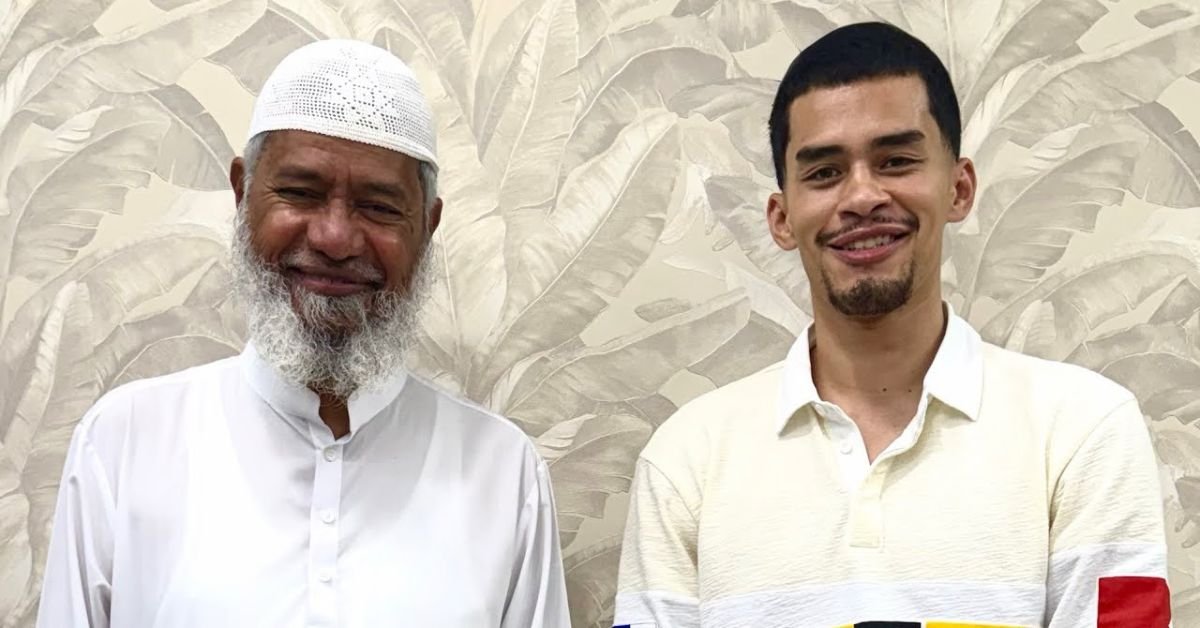
In a nearly three-hour conversation that has quickly gone viral, prominent Islamic scholar Dr. Zakir Naik sat down with American content creator SNEAKO to discuss faith, dawah, politics, and the pressing need for unity within the global Muslim Ummah.
The interview, titled SNEAKO Interviews Dr Zakir Naik: Unite the Ummah, was released on April 19 on SNEAKO’s secondary channel SHNEAKO.
As of April 22, the full video has already surpassed 262,000 views and 12,000 likes, with numerous clips circulating widely on social media.
When directly asked about being labelled Shia, Sunni, Hanafi, Salafi, or Sufi, Dr. Naik gave a straightforward response that has resonated with many viewers:
“I’m a Muslim. Alhamdulillah. The Quran nowhere tells us to call ourselves Hanafi, Shafi, Maliki, Shia or Sunni. It says call yourself Muslim.”
Naik, who has resided in Malaysia since 2016, used the platform to address longstanding questions about his departure from India.
He stated that the Indian government’s actions were not primarily due to his Muslim audience but rather his growing popularity among non-Muslims, particularly Hindus.
His public lectures, which emphasise similarities between faiths and promote Hindu-Muslim harmony, reportedly threatened “divide and rule” politics aimed at securing vote banks.
“I can enter India, but they will not allow me to leave,” Naik explained.
“They will welcome me if I go in, but they will not allow me to go out.”
He further revealed that an emissary from Prime Minister Narendra Modi’s office later approached him with offers of support if he returned and aligned with certain government positions, including on Kashmir.
Naik said he declined, citing his inability to support policies he viewed as unjust.
From Medicine To Global Dawah Pioneer
Born into a family of doctors, Naik originally trained in general medicine with aspirations of becoming a renowned cardiologist.
His path changed after encountering the late South African scholar Sheikh Ahmed Deedat during medical college.
Inspired by Deedat’s video lectures, Naik transitioned from “doctor of the body” to what he calls “doctor of the soul,” eventually leaving clinical practice to focus full-time on dawah.
In 1991, he started a small organisation with a monthly budget of roughly $80–90 and one staff member.
It grew rapidly into what he describes as the world’s largest private Muslim dawah body at its peak in Mumbai, employing over 500 full-time staff and more than 10,000 volunteers.
In 2005–2006, Naik launched Peace TV, which he claims became one of the most widely viewed religious channels globally, reaching hundreds of millions across English, Urdu, Bengali, and Chinese broadcasts.
He pioneered high-quality production standards, shooting major events in 8K using professional film cameras.
Despite these achievements, Naik repeatedly attributed success not to personal ability but to divine support.
“It is Allah’s help,” he said.
“If Allah helps you, none can overcome you.”
Core Message: Unity In The Face Of Division
A central theme of the interview was the current state of the Muslim Ummah.
Naik noted that Muslims now number more than 2.07 billion, over 25% of the world’s population, the highest proportion in history.
However, he warned that internal disunity has left the community vulnerable.
Citing a hadith from Sunan Abu Dawud, he described contemporary Muslims as “like froth” on the sea: large in number but directionless, overly attached to worldly life (dunya), and fearing death more than they should.
He urged believers to set aside differences, even major ones, when facing external aggression, drawing on the example of the Prophet Muhammad’s companions.
“Focus on common terms,” Naik repeated, referencing Quran 3:64.
He stressed that dawah must be conducted with hikmah (wisdom) and beautiful preaching, as instructed in Quran 16:125, rather than anger or confrontation.
Simple Lifestyle Despite Success
Despite building a large media and dawah infrastructure, Naik described maintaining an intentionally simple personal life.
He and his wife live on approximately $500 per month.
He drives a Toyota Camry and has committed to giving at least 51% of his business profits to charity every year, referring to Allah as his “51% business partner.”
He noted that while his businesses have owned luxury vehicles such as Maybachs, Lamborghinis, and Bentleys, they were primarily used for commercial purposes rather than personal use.
“Money should run after you, not the other way around,” he said. “We are in this world for the hereafter.”
Naik also offered advice to Muslims living in the West facing propaganda and fitnah.
He recommended protecting one’s iman through consistent prayer, keeping the company of knowledgeable scholars, and, where feasible, considering hijrah to Muslim-majority countries.
He praised Malaysia, particularly Putrajaya, as an ideal environment.
The interview concluded with Dr. Naik gifting SNEAKO a rare attar used on the Kiswa of the Kaaba, a fragrance that, he noted, “money cannot buy.”
Growing Online Impact
The release has sparked widespread discussion across social media, with many viewers highlighting Naik’s emphasis on unity, sincerity, and practical guidance amid ongoing global challenges facing Muslim communities.
Dr. Zakir Naik remains one of the most recognised international voices in Islamic outreach.
His message in the SNEAKO interview reinforces a consistent theme from decades of public work: call people to Allah with wisdom, live simply for the hereafter, and foster solidarity within the Ummah.
Watch the full interview here
Post's Author